Twenty scenarios
When They Say No
Twenty sentences, and what to do about each one
If you want the no to cost them something, all you need is the sentence to say and the email to send.
That is the whole book. Here is why those two things are what work.
You came out of a meeting and something went sideways in a way you cannot name.
Somebody said one of these.
Let's monitor that and revisit at the next annual review.
We don't have the staffing right now.
Don't worry about the wording, this is just a draft.
Everyone was pleasant. You are in the car and you cannot tell whether you were turned down.
You were. It just arrived in a form that leaves nothing behind to point at.
Checkout link not yet configured. Set it in src/config.ts.
Because the no is designed not to look like one
"We'll monitor it" is the clearest example.
Monitoring is somebody watching. It has no minutes attached to it, no provider assigned to it, and nothing on the page anyone can be held to twelve months from now.
You asked for a service. What came back was a schedule. The request was turned down without the word being used, and a year of nothing got agreed to out loud by everyone including you.
A refusal to change the provision of FAPE carries a written notice requirement under 34 CFR 300.503 whether or not anyone announced it as a refusal.
That last sentence is the leverage, and almost nobody uses it, because on the day it does not feel like a refusal. It feels like a plan.
So arguing harder in the room is the wrong move
The parent who comes in hot loses that room every time. Not because being angry is wrong. Because the argument is with people, and people are not what the year gets decided by.
The fight is with the document.
You can win the conversation, get warm agreement from everyone at the table, go home, and get an IEP that says the same thing it said before you walked in. The person who agreed with you may be in a different building by September. The document will still be there.
And the two things that actually move it are small
One sentence, said flat, while you are still in the room. One email, sent within two days.
The sentence's job is to convert a feeling somebody will have in eleven months into a threshold somebody has to say out loud today, while you write it down.
If we monitor for a year, what would have to show up in the data for the team to say monitoring wasn't enough? I want to know the number now, not next June.
The email's job is the record. It writes down whatever answer you got, in your words, dated, and asks them to correct you in writing if you have it wrong.
Neither one requires you to be quick on your feet or to know the law better than the person across the table. Both are written out for you.
The relationship
But this is the part where you worry about the relationship
You have another eight years with these people. You have thought about that, and it is a fair thing to think about.
So notice what is not in this book.
Nothing here is aimed at anybody in that room. There is no line that puts a case manager on the defensive, no accusation, no move that requires you to catch someone out. Every sentence in here can be said in a flat voice by somebody who is not enjoying it.
Asking for prior written notice is an ordinary procedural step. Said without heat, it sounds like one, because it is one.
The book also does not overclaim on your behalf. Scenario 13 covers "that's not in the budget," and it will tell you plainly that the thing you read on the internet about cost never being a factor will get you corrected by someone who knows the case law better than you do. What it gives you instead is narrower and holds up.
That is the trade being made throughout. Nothing that feels satisfying to say and falls apart when tested.
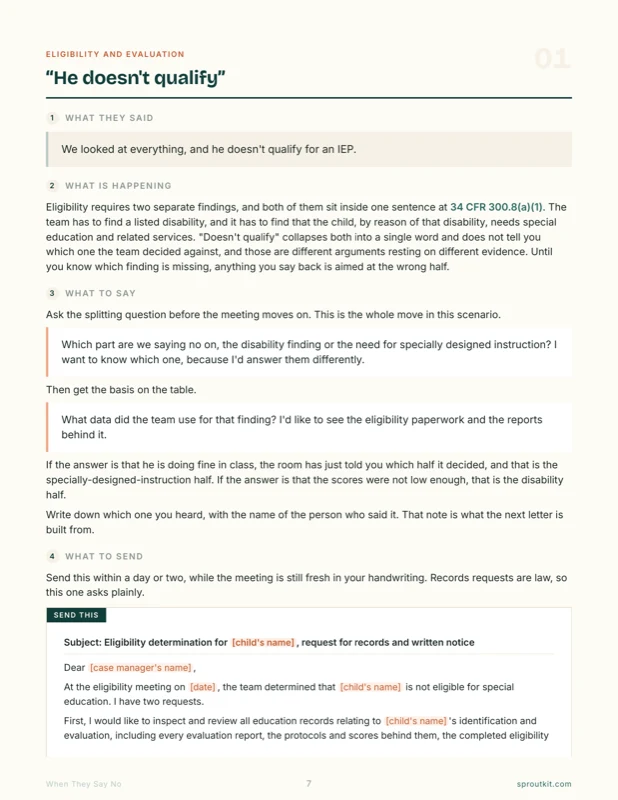
Twenty scenarios, two pages each, five fixed beats
Every one runs the same way. What they said. What is happening. What to say while you are still in the room. What to send afterward. What to do if that does not work.
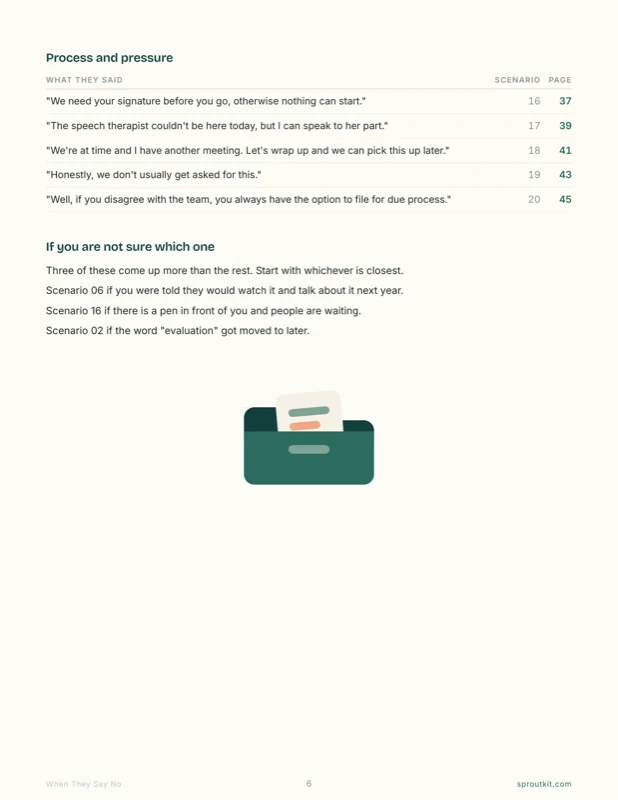
| Family | The five sentences |
|---|---|
| Eligibility and evaluation | He doesn't qualify. Let's try interventions first. That's not an assessment we do. She's too young to test. His grades are fine. |
| The document | We'll monitor and revisit. We all know what we're going for here. Same goals as last year. We can't put that in the IEP. This is just a draft. |
| Services | We don't have the staffing. Consultation is just as effective. That's not in the budget. He gets that in gen ed. The aide is shared. |
| Process and pressure | You need to sign today. That person couldn't make it. We're at time. We don't usually get asked for this. You can file for due process. |
Nineteen of the twenty carry a letter written to be sent as it stands. Copy it, fill in the brackets, send it.
Scenario 19 carries none on purpose, because the request it covers is still pending and writing anything would change the subject to you.
How you use it
It is a shelf, not a read
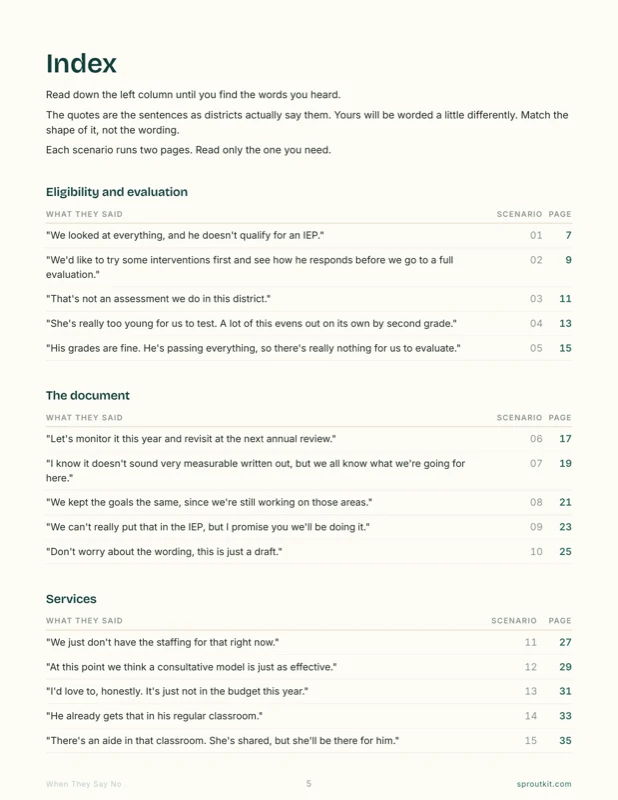
Open the index at the back. Read down the left column until you find the words you heard. Turn to that scenario, read the two pages, do the thing.
Skip the other nineteen. You need one thing off it today.
The quotes in the index are the sentences as districts actually say them. Yours will be worded a little differently. Match the shape of it.
$27. Once.
$27. Once.
Thirty-odd pages, print-ready, yours to keep.
If your meeting is tomorrow, print the one scenario you need and put it on top of the folder.
Checkout link not yet configured. Set it in src/config.ts.
Where this stops
Where this book stops
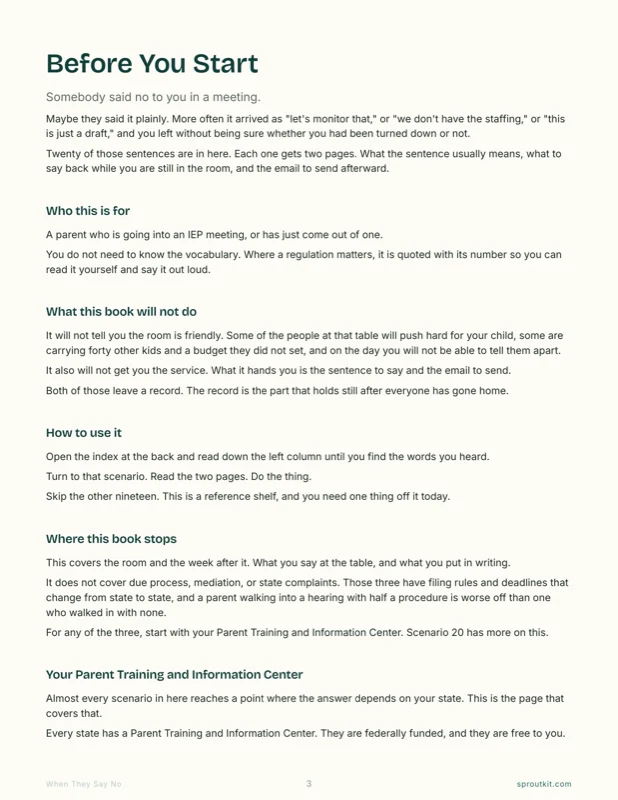
This covers the room and the week after it. What you say at the table, and what you put in writing.
It does not cover due process, mediation, or state complaints. Those three have filing rules and deadlines that change from state to state, and a parent walking into a hearing with half a procedure is worse off than one who walked in with none. Scenario 20 routes you to the people who handle that.
It will also not get you the service. What it hands you is the sentence and the email. Both leave a record, and the record is the part that holds still after everyone has gone home.
Who this is for
A parent going into an IEP meeting, or one who has just come out of one.
You do not need to know the vocabulary. Where a regulation matters, it is quoted with its number so you can read it yourself and say it out loud.
If your first meeting has not happened yet and nothing has gone wrong, The First Meeting is free and it is the better starting point. Send the email, write your page, and go. This one will be here when you need it.
Before you use any of it
This is information, not legal advice. Every legal claim carries the federal regulation it comes from so you can read it yourself.
This covers federal law. Your state adds its own rules on top, and sometimes shorter timelines.
Almost every scenario in here reaches a point where the answer depends on your state. Your Parent Training and Information Center is federally funded, free to you, and staffed by people who do this daily. They will tell you your state's timelines, explain what a notice you received actually said, and tell you whether your situation points toward mediation, a complaint, or due process.
They are not attorneys and they do not represent you at a hearing. They will tell you when you have reached the point of needing one.
Find yours at parentcenterhub.org, searchable by state.
The record is the part that holds
You will be in this room again next spring, and the spring after that.
What you remember of today will have gone soft by then. What you sent in writing, dated, will not.
Checkout link not yet configured. Set it in src/config.ts.