Free
What to bring to the first one
The draft usually exists before you walk in, which makes the meeting a revision session. This is the paper you bring to it. Print it, fill it in by hand, take the folder.
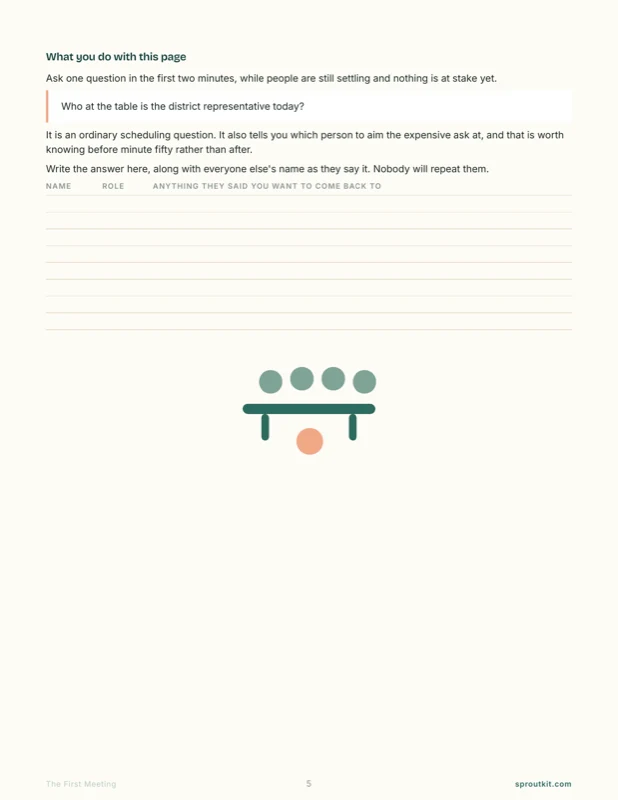
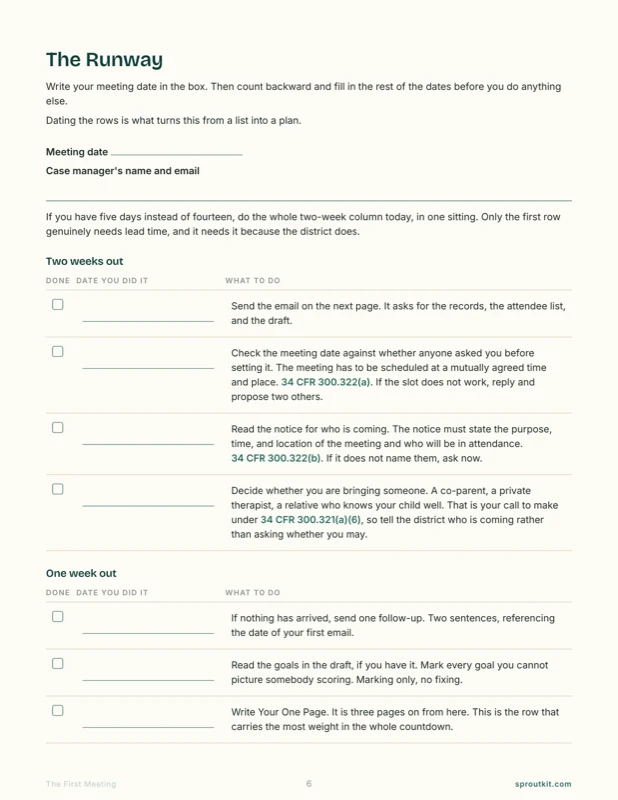
If you want your first IEP meeting to go differently, all you need is your own paper on that table.
That is the whole thing. Let me show you why it works before you hand over your email address.
You have a date on the calendar. You have a packet you have read four times without absorbing. You have been told to come and share your thoughts about your child, so you have been rehearsing what to say.
Here is the part nobody mentions in the letter they sent you.
The draft usually exists days before you get there. Staff are allowed to write it among themselves, and that drafting session is not a meeting you have a right to attend. 34 CFR 300.501(b)(3).
So the ninety minutes you are dreading is a revision session. There is already a document. The question is whose paper gets revised into it.
The room
Because you have been preparing for the wrong meeting
You are getting ready to listen well. To be organized, to be pleasant, to be the parent they want to help.
That instinct is sound and it is why most first meetings go the way they do. A parent who prepares to listen arrives with nothing in their hands. Everyone else at that table arrives with the file.
Eight people sit down. You know two of their names. The rest get introduced once, quickly, in the first ninety seconds while you are still finding a pen.
Then evaluation results. Then present levels. Then goals. Then minutes. Then placement. Then signatures, and the room stands up.
Your items come up in the middle if you raise them. At the end if you wait to be asked.
The two weeks
So the leverage is in the two weeks before the door opens
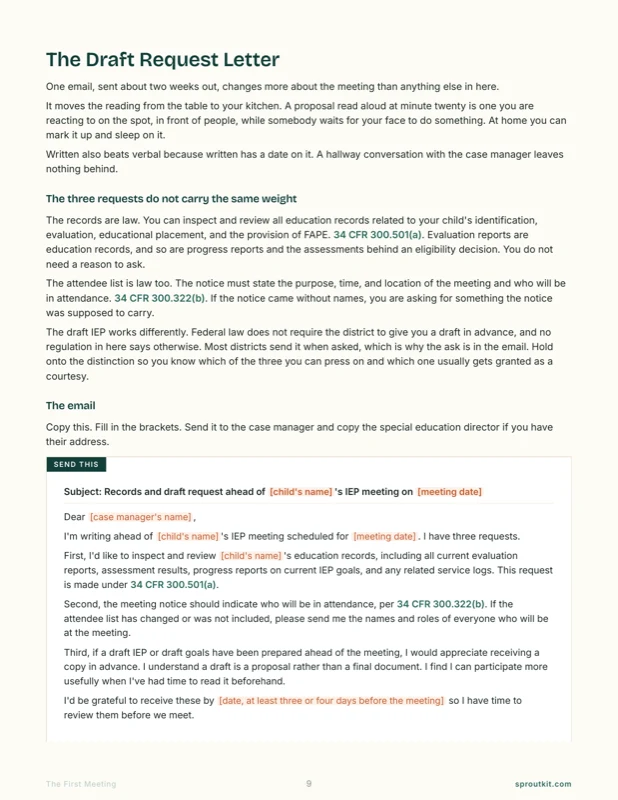
One email, sent about two weeks out, changes more than anything you could say on the day.
It asks for three things. Your child's education records, which you have the right to inspect and review under 34 CFR 300.501(a). The attendee list, which the notice was supposed to carry under 34 CFR 300.322(b). And the draft, which federal law does not require them to send you, and which most districts send anyway when asked.
That email moves the reading from the table to your kitchen.
A proposal read aloud at minute twenty is one you react to on the spot, in front of people, while somebody waits for your face to do something. At home you can mark it up and sleep on it.
On the day
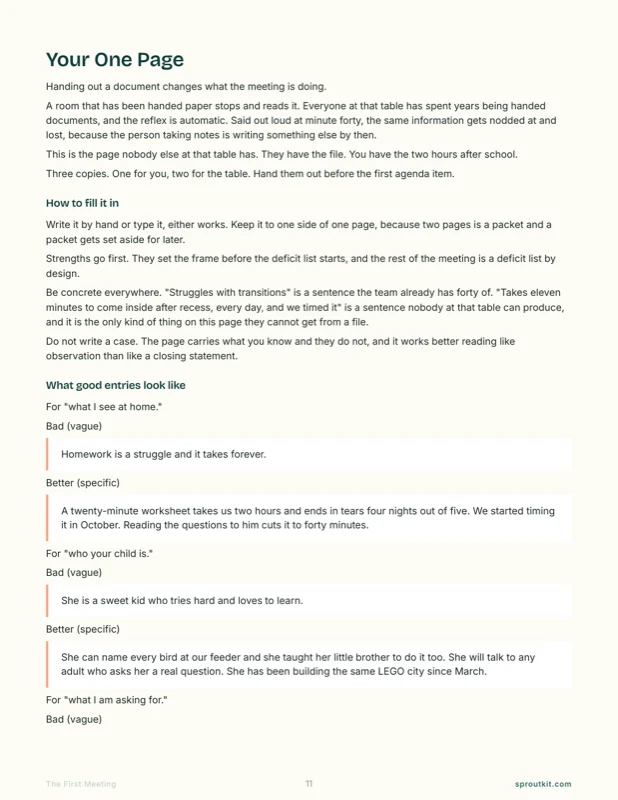
And on the day, you hand something across the table
A room that has been handed paper stops and reads it. Everyone at that table has spent years being handed documents and the reflex is automatic.
The same information said out loud at minute forty gets nodded at and lost, because the person taking notes is already writing something else.
They have the file. You have the two hours after school. That is the only document in the room they cannot produce.
The difficult parent
But you do not want to be the difficult parent
Almost every parent going into a first meeting is carrying this one, and it does more damage than anything they misunderstand about the law. It is the reason people sign things.
So look at what is actually in here.
Asking for records. Asking who is coming. Asking someone to write down what they just promised. Asking what a word means.
The team writes IEPs for a living. Being asked to put something in the document is the most ordinary request you can make of them, and asking it eight times in one meeting is not rude.
None of it requires a raised voice or a clever line. You can say every sentence in here badly, in a shaky voice, reading off the page instead of looking at anyone, and it still does what it does.
What it will not do
It will not tell you the room is friendly.
Some of the people at that table will push hard for your child. Some are carrying forty other kids and a budget they did not set. On the day you will not be able to tell those two apart, and nothing in here will help you sort them.
What holds still is the regulation, the document, and the dates. What you asked for in writing, and what came back.
What is in it
Six pieces, and most of them you write on
What happens in the room
The order it usually goes in, the six seats the district has to fill under 34 CFR 300.321(a), and which chair is the one that can authorize a cost.
The Runway
A countdown you date and work backward from. Fourteen days out to meeting day. If you have five days instead of fourteen, it tells you what to do today in one sitting.
The Draft Request Letter
The email, written out. Copy it, fill in the brackets, send it. It carries its own citations.
Your One Page
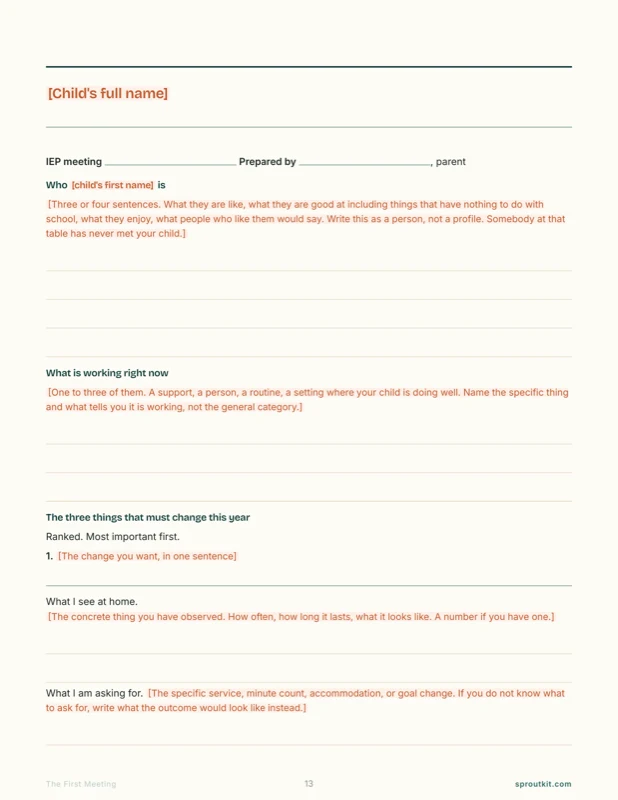
The page about your child that you hand across the table before the first agenda item. With filled-in examples of what a vague entry looks like next to a specific one.
Three Sentences
For the three moments that come up in almost every first meeting. Someone promises something out loud. You do not know what a word means. They want you to sign right now.
Where this stops
The part most free things leave out.
A tablet works until someone starts talking and you are scrolling. Paper does not go to sleep and does not need you to look away from the room.
Free. No catch.
Free. No catch to explain.
Give me an email address and the PDF comes to you.
It is the first meeting. It is the one where the least is known and the most gets set, and putting a price on it did not sit right.
Who this is for
Who this is for
A parent going into their first IEP meeting.
Somebody at the school said the word evaluation, or the testing already happened, and now there is a date and a packet.
You do not need the vocabulary. Where a regulation matters, it is quoted with its number so you can read it yourself and say it out loud.
If you have been through three of these already, this one is probably below where you are. The next section is closer.
When the answer is no
The First Meeting covers one meeting, and it says so on its last page.
What it does not cover is being told no. Not the flat kind. The kind that arrives as "let's monitor that and revisit next year," or "we don't have the staffing right now," or "he already gets that in the general education classroom." You leave unsure whether you were turned down at all.
That is When They Say No. Twenty sentences a district uses, two pages each. What the sentence usually means, what to say back while you are still in the room, and the email to send afterward. Nineteen of the twenty carry a letter written to be sent as it stands. $27.
Get the free one first. It will tell you when you need the other.
Before you use any of it
This is information, not legal advice. Every legal claim carries the federal regulation it comes from so you can read it yourself.
This covers federal law. Your state adds its own rules on top, and sometimes shorter timelines.
Your state's Parent Training and Information Center is federally funded, free to you, and staffed by people who do this daily. They will go through your child's evaluation reports with you and tell you your state's own timelines. Find yours at parentcenterhub.org, searchable by state.
Call before anything is on fire. The first conversation is easier that way, and they will have your file open the next time.
Walk in holding something
Walk in holding something
The meeting is a revision session for a document that already exists.
You can arrive to react to it, or you can arrive with the records read, a page in your hand, and three sentences on top of the folder.